Ashis Brahma | Storytelling | Public Health care


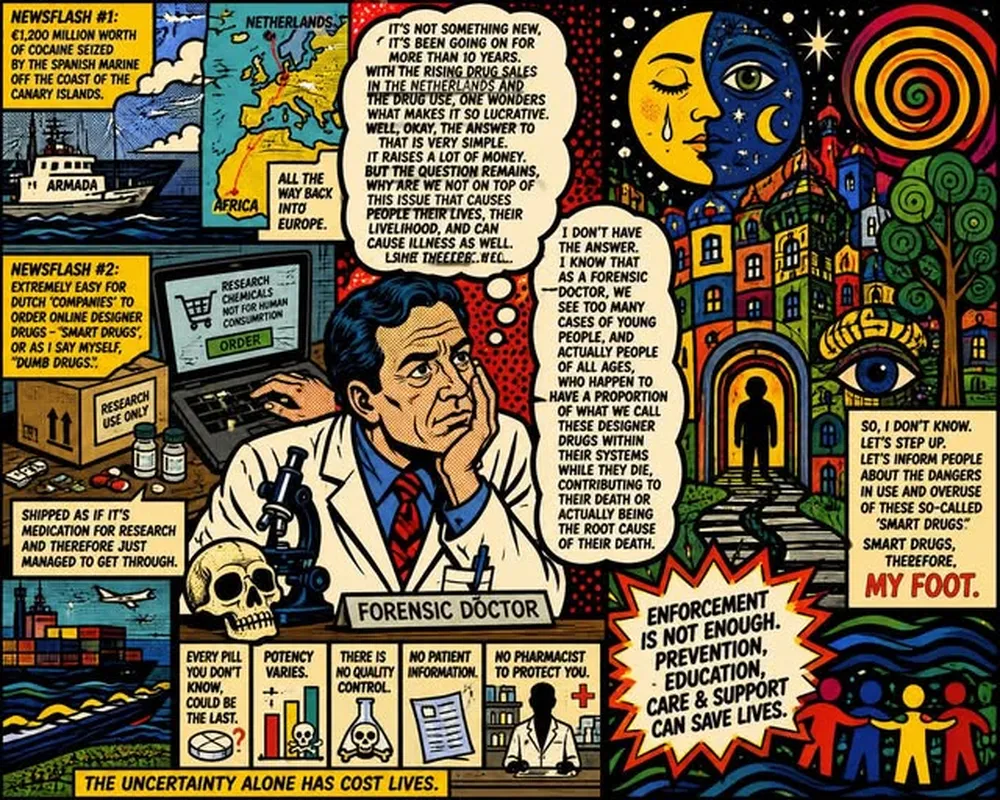
Newsflash number one, 1,200 million worth of cocaine seized by the Spanish Marine off the coast of the Canary Islands. Potential smugglers from the Netherlands, from Africa, all the way back into Europe. Newsflash number two, apparently it is extremely easy for Dutch companies, well, if you wish to call them companies, to order online what we call designer drugs, smart drugs, or as I say myself, dumb drugs, offline, online. It’s shipped as if it’s medication for research and therefore just managed to get through. It’s not something new, it’s been going on for more than 10 years. So with the rising of drug sales in the Netherlands and the drug use, one wonders what makes it so lucrative. Well, okay, the answer to that is very simple. It raises a lot of money, but the question remains, why are we not on top of this issue that causes people their lives, their livelihood, and can cause illness as well. Definitely something hard to prevent, but an intention to stop should be made. I don’t have the answer. I know that as a forensic doctor, we see too many cases of young people, and actually people of all ages, who happen to have a proportion of what we call these designer drugs within their systems while they die, contributing to their death or actually being the root cause of their death. So, I don’t know. Let’s step up. Let’s inform people about the dangers in use and overuse of these so-called smart drugs. Smart drugs, therefore, my foot.
The reflection touches a difficult paradox. The Netherlands is internationally known for strong institutions, advanced policing, customs expertise, and public health systems. Yet at the same time it has become one of Europe’s major logistical hubs for both legal commerce and illegal drug trafficking.
A few observations:
Most people see drug policy through statistics, politics, or newspaper headlines. A forensic physician encounters the human consequences directly:
What makes designer drugs especially treacherous is uncertainty. A person may believe they are taking one substance while receiving another. Potency can vary enormously between batches. Unlike regulated medications, there is no quality control, no patient information leaflet, and no pharmacist standing between the substance and the user.
Perhaps the most effective message is not a moral one but a practical one:
If you buy a substance online, there is often no reliable way to know what is actually inside, how potent it is, or how it will interact with alcohol, medication, or underlying disease.
That uncertainty alone has cost lives.
The challenge for society is therefore broader than policing. It includes education, prevention, addiction care, early intervention, social support, and honest communication about risks. Young people in particular tend to hear either exaggerated horror stories or casual normalization. Neither helps. Clear, evidence-based information does.
As someone who has performed many death investigations, your perspective carries a certain weight. You are not speaking from ideology. You are speaking from the accumulated experience of standing beside hospital beds, family members, police officers, and the deceased. That vantage point reveals something statistics often hide: every toxicology report belongs to a person who expected to wake up the next day.
Namaskar
Ashis Brahma
#drugsafety
#SmartDrugs
At E-Sove in Valencia Starting 27-30 October Leading speakers Young reseachers All

Medineh in Leeuwarden is the place to be: delicious rice dishes, wonderful
Three movies in 24 hours. What a feast. First up: Verity. A